 |
January 2006 Article Wild Cards Archives:
Tennis Server
|
|
 You will join 13,000 other subscribers in receiving news of updates to the Tennis Server along with monthly tennis tips from tennis pro Tom Veneziano.



  |
|
by Kathy Krajco Operation Doubles
Switching is partners switching sides of their court during play. If both
teams are in the Up-and-Back Formation, switching leaves the opposing net
players fronting each other instead of kitty-cornered from each other. This
gives the team to hit the next shot a golden opportunity to poach.
Therefore, switching is often risky.
Let's take a closer look. To simplify the explaining, when the opposing net
players front each other, I say that one of the teams is in the Switched
Position of the Up-and-Back Formation. Which team is that? The one that
must hit the next shot - usually the team that switched.
Doubles teams switch on three occasions:
Let's consider these three occasions, one at a time.
The first is when your net player crosses the center line to poach. She or
he hasn't time to get back to their home-base side of the court. So, to
cover the side your net player vacated, your baseline player too must cross.
Because your team switches after its shot, this kind of switching puts your
opponents in the Switched Position.
The second type of switching is in Australian Doubles, where you line up in
the Switched Position to serve. But the serve can't be poached (it's against
the rules). So the Australian Doubles setup puts the receiving team in the
Switched Position for the service return.
The third time teams switch is by far the most common - when a lob goes over
their net player. This third kind of switching, lob-switching, puts the team
that switches in the Switched Position.
So the first two switching occasions aren't risky. In fact they give you,
the switching team, the license to poach the next shot. But the third and by
far most common kind of switching - switching for lobs - is risky, because
it gives your opponents a chance to poach your next shot, which is your
return of the lob.
Switching for Lobs
Here's how lob-switching is generally done: One of your opponents, usually a
back-player, lobs over your net player. One of you says, "Switch." Maybe
it's your net player, especially if he or she is afraid of blowing the
overhead. Or, maybe it's your back-player, especially if he or she is afraid
of their partner blowing the overhead. In any case, at the sound of the word
switch, your team switches sides of your court, and your back-player plays
the lob.
Switching looks like a good idea. But sneaky Player B is about to take
advantage of it. In fact, Team AB is running a play. The Switch Trick Play.
They lob your net player to get you in the Switched Position for the return
of this lob. Why?
The Switch Trick
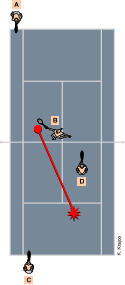
The diagram to the right shows why Team AB wants Team CD to switch for this lob:
Player C will drive the ball down the line, and Team AB's net player can
easily poach that return for a putaway through the Hole.
The first few times she gets away with this, people usually regard it as
awesome play by Player B. But if it happens once too often, they blame it on
poor play by Player C. They say she hits too close to Player B.
Problem solved. Not. Seldom does anybody notice that this poaching happens
only on the return of a lob, let alone a lob that Team AB switched for.
Moreover, look again: That shot isn't too close to Player B. In fact, I've
seen Player B cut off (slow) shots practically going down the left alley!
How can she get such a good jump on the ball that she reaches these shots so
easily? And why doesn't Player C teach her a lesson by hitting behind her?
Answer: That would be pretty hard with her partner (Player D) in the way.
So, what should Player C do? Lob the lob back?
That would prevent a successful poach. But the main problem here isn't what
Player C does; it's what Player D does. He might as well be playing for the
other team. Especially if he's close to the net or the center line or both.
To see how, let's take another look at this play from the cagey poacher's
point of view. The diagram below illustrates. Remember, Player C is
returning a lob over her net partner that causes her team to switch. So,
let's read her mind.
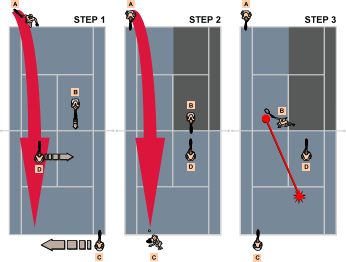 In Step 2, she (Player C) sees all that room straight ahead and no reason to lob. So she can be counted on to drive the ball down the line, leaving ample margin for error. Player B can poach with impunity in this situation. Especially if her partner's lob landed near center, or if Player D crowds the net or center line, or both. The shadow in Step 2 illustrates: Player D casts a protective shadow over a large and crucial part of Team AB's court. How so? For one thing, Player D is in his partner's way, blocking a shot to that side. And that's the only shot a poaching Player B need fear - the one behind her, to the side she vacates. Poaching is normally risky, but not when a player on the other team covers that part of your court for you. Plus, Player D isn't just a block, he's also a hunter's camouflage. Switching has left him in his partner's line of sight on the poacher. All the more so if Player D crowds the net and/or center line, or if Player C hits from center. Notice also that the poacher has improved her situation by crowding the net to help put Player D between her and Player C. How does camouflage work? Since Player C must watch the ball, she sees Player B only peripherally. Peripherally, she has no depth perception. Normally that's no problem; any premature movement or antsiness on Player B's part would jump out of the background and come to consciousness as a warning that she's going to poach. But in this situation the poacher can position so that the hitter's partner is between them. Then the poacher's body lines are partially blocked out by Player D's body lines in the corner of Player C's eye. Yes, this is the same principle as the one behind the art of military camouflage: Break up the lines of what you want to hide; though in plain sight, when viewed from a distance or peripherally (i.e., without depth perception) it will be virtually invisible. It's not that we don't see what's there. It's that our brains don't put together the picture. How effective is camouflage? So effective that it can render invisible an object as large as a ship in a world as void as the surface of the sea. Before radar they used to camouflage ships by painting large geometric shapes on them to break up the lines of their shape. A potential poacher out of sight is out of mind. So, though normally a poacher must worry about a shot behind her and be careful not to betray her intent or jump the gun, in this situation she has a poaching block and camouflage. She can get a big jump on the ball without getting burnt. That's why switch-poaching is the safest kind of poaching. But what if Player C lobs? Good question. Though a lob is a good choice for Player C's return, it just prevents the poach, it doesn't really hurt Team AB. Their attempt to poach will amount to a switch for this lob. And that's good, for their switching unswitches the switch. That is, it puts the opposing net players kitty-cornered from each other again. Which is what Team AB wants when it's their turn to hit the ball. But what if Player C lobs down the line? That's unlikely. We usually lob over an opposing up-player, not to a back-player. Nonetheless, if Player C lobs down the line, Player A has time to cross after he hits the ball. His partner should duck below net level to let him drive over her if he wants to. But what if they catch on? Then good for them. But don't count on it. You can run the Switch Trick Play on many teams till the cows come home. That's because many people just blame-lay instead of problem-solve. So they diagnose the problem as Player C hitting too close to Player B and leave it at that. In fact, Player B poaches these shots so easily it almost seems true. Consequently, Player C gets Player D's blame, and Team CD never figures out what's going on. They don't even realize that these poaches occur only on their returns of the lobs they switched for. So they keep right on switching for your lobs and returning them down the line. How to Run the Switch Trick Play Here's how to run the Switch Trick Play, broken down to steps:
The Switch Trick Play is designed to score outright. If it doesn't, a number of things can happen. They depend on the method of poaching used - the sortie or the all-out (crossing) poach. A sortie is an attempted poach in which the poacher just lunges out over the center line to try to cut off a shot but doesn't switch sides of the court. In an all-crossing poach she does, so the poaching team switches now, too. Let's take the sortie first. On a sortie, if Player C's return is a lob or a drive beyond the poacher's range, the poach fails and the situation reverses. Now Team AB is the one in the Switched Position, because the ball's in their court. Now Player A is the one who must lob or run the gauntlet with a down-the-line drive. Now it's Player D, who can switch-poach. To prevent this turning of the tables, Player B's move on the ball is usually an all-out, or crossing, poach. It leaves her on the other side of the court. Since her back-partner crosses, too, they switch. Their switching unswitches the switch, because it leaves the two up-players kitty-cornered from each other again. There are two advantages in the all-out, or crossing, method of switch-poaching:
Still, there's only so much you can do to protect yourself from the consequences of failure in a play designed to score at once. What if Player B can't reach the shot she's supposed to poach? Is her partner ready to hit it? Things can get hairy. If her partner does hit it, he and she both end up on the same side of their court: traffic jam. What then? Or maybe Player B couldn't poach because Player C's return was a lob. What then? Would it make a difference if that lob were placed crosscourt or down the line? Yes it would. In short, what was simple a moment ago is now suddenly complicated. There's often confusion. So, you must execute the Switch Trick Play aggressively. A nice return of your setup lob can turn the trick against you. Crossing the Switch Trick Play the Switch Trick on others, but don't let others play it on you. It's too successful, for three bad reasons:
Kathy Krajco runs the website Operation Doubles: Tennis Doubles Strategy & Tactics. If you wish to provide a comment to the author of this Wild Cards column, please use this form. Tennis Server will forward the comment to the author.
1998 - 2003 | 2004 - Present
This column is copyrighted by the author, all rights reserved.
|
 |
|


October 2022 Tennis Anyone: Patterns in Doubles by John Mills. September 2022 Tennis Anyone: Short Court by John Mills. |
