 |
February 2002 Article Tennis Server
|
|
 You will join 13,000 other subscribers in receiving news of updates to the Tennis Server along with monthly tennis tips from tennis pro Tom Veneziano.



  |
|
The Flight Of The Tennis Ball
Last month, we reviewed some of the basic physics which govern the flight of the tennis ball. This month we'll go through some math and you can try out a little interactive software program which demonstrates how trajectories change with speed, spin, height, and air density. Let's get right to it! What governs the speed of Greg Rusedski's serve after it leaves the racquet? In a mathematical nutshell it is: Force = Weight + Lift + Drag or (1) F = W + L + D, where, W is the mathematical notation for Weight, L for Lift, and D for Drag (2a) W = mg, where m is the mass of the ball and g is the acceleration of gravity.
(2b) L=1/8 CL rpv2
d2
where r is the density of air, d is the diameter of the ball, v is the velocity. CD and CL are the coefficients of drag and lift. The forces -- weight, lift and drag -- do not all act in the same directions. Last month, in Trajectories 101A, we discussed that the forces all interact like a "tug-of-war." All the forces have to be added together to determine the magnitude of the force and the direction it will act. Remember the story of Newton's apple. The apple fell down (vertically) off of a tree. Weight and gravity only act in a negative vertical direction. For this reason the math equations are separated into the forces that act in the horizontal or "x" direction and the forces that act in the vertical or "y" direction.
(3a) ax=rpv
d2/8m (-CLvy - CDvx)
where t = time, ax is the acceleration of the ball in the horizontal direction, ay is the acceleration of the ball in the vertical direction. The two equations above define the acceleration of the ball. (Notice only equation 3b - ay - acceleration in the vertical direction has gravity in it.)
(4a) vx=vx0 + axt
vx is the velocity in the horizontal direction, vx0 is the initial velocity in the horizontal direction, vy is the velocity of the ball in the vertical direction, vy0 is the initial velocity in the vertical direction . The above two equations define the velocity of the ball.
(5a) x=x0 + vx0t + 1/2axt2
x is the position in the horizontal direction, x0 is the initial position in the horizontal direction, y is the position of the ball in the vertical direction, y0 is the initial position in the vertical direction. The above two equations define the position of the ball. The math isn't here to intimidate or to be esoteric. There are many simple insights you can determine with these equations. These are the same types of equations used initially to determine if a larger ball would slow the game down. Reviewing the sports ball literature, you may see different symbols, different formulations, minor differences in + or - signs depending on the conventions for direction and spin the researcher used, the equations broken down into greater detail or differently since a computer code will solve them, but in general all sports ball equations boil down to the equations presented here. The equations above are for a 2-dimensional case -- that is a ball that only moves horizontally and vertically -- which lends itself to paper and pencil calculations for topspin, flat and underspin balls. (Perhaps in the future we'll continue this article for the 3-dimensional case - Trajectory 201A.) What happens if the size of the ball is changed? Let's make the diameter of the ball 6% larger and let's keep the weight the same. This is the size of the new Type 3 ball. What happens to the different forces (weight, lift and drag) if the diameter of the ball is increased by 6%? First of all we said that the weight of the ball would be the same. The weight does not change, but looking at equations 2a and 2b, the lift and drag will change because the diameter affects those forces. By looking at the equations you might be saying, "It's obvious, the larger the ball the more drag you'll add". Yes, that would be true if everything else in the equation for drag stayed the same. But actually this hasn't always been so clear cut, because the lift and drag coefficients are not specific numbers - CD and CL can change. For a tennis ball serve, CD ranges between 0.5 and 0.7. CL ranges between 0.0 and 0.3.
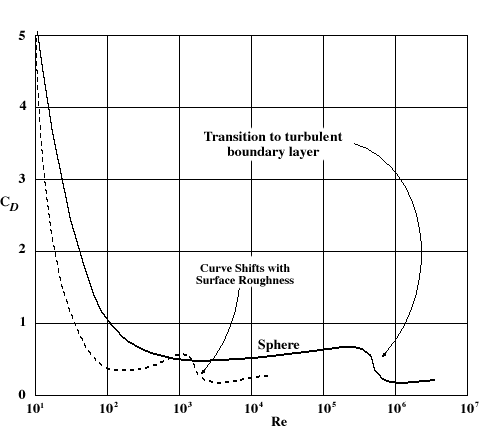
This is the drag coefficient curve for a sphere. The horizontal or x-axis is labeled Reynolds number and the vertical axis labeled CD. You can read more about the meaning of the Reynolds number on our tennis sport science web site, but in a nutshell for our specific problem a higher Reynolds number means higher speed, greater density or longer ball diameter. See that drop in the drag coefficient for a sphere between Re = 105 and 106. For the researchers investigating the use of a larger ball to slow the game that drop in CDwas a big concern! Most sports balls have CD curves which resemble this drag curve. So let's say our serve speed and ball size places the Reynolds number in the area of that higher CD just before that CD curve drops. Now a new ball is introduced with a larger diameter, resulting in a higher Reynolds number. Suddenly you're in the part of the drag curve where the CD drops and is much lower. You've created a larger ball with a much lower CD and consequently less drag. Instead of slowing the game, you could speed up the game. The good news is this drag reduction doesn't appear to occur on a tennis ball. The fabric cover on the ball is so rough and porous that unlike all other sports balls and spheres the big drop in CD never appears to occur for typical tennis ball speeds. What happens if you play tennis at higher altitude? You know the air is "thinner" at higher altitudes -- more formally, the density of the air is lower. There are less molecules of air in the same amount of space. The density of air at sea level at 70o F is 1.2255 kg/m (kilograms/meter). The density of air in Mexico City is about 0.98 kg/m. (Mexico City is located at 2300 meters or about 7500 feet above sea level.) Anyone that doesn't think air density has a big effect on sports balls should consider the training protocols for the USA Volleyball players. Their training center is located in Colorado Springs, Colorado (high altitude). Practicing at lower air density was a big concern for the men's team when they competed in the 2000 Olympics in Sydney at sea level (higher air density). While the women tend to hit flat serves (more like knuckleballs), the men have higher velocity topspin serves. Drills have been developed and continue to be refined so that the ball will be placed correctly at sea level while the players train in Colorado Springs. Placement differences of 2-4 feet are not unusual and can certainly make the difference between "in" and "out." Now you probably know that there are tennis balls made especially for high altitude play, but once the ball is in the air, physics takes over. To have more fun with this, we posted a little interactive JAVA web-based software program based on the trajectory equations you can try it out for yourself. You can change velocity, height the ball is struck, spin rate and set the location of the court to San Francisco (sea level), Mexico City (more than a mile above sea level) or Mount Everest (way up there, over 5 miles above sea level). See where the ball lands as you change these parameters. (To make comparisons between trajectories sometimes I tape a transparency over the computer monitor and trace the trajectories using different colored pens.) A ball is served at 78 miles/hour (100 meters/sec) with heavy topspin on it. Based on what you know, which ball will go farther -- a ball at sea level or ball in Mexico City? Based on what you know, which ball's trajectory will curve more -- the ball at sea level or the ball at Mount Everest. Is the trajectory in the software going to match your next serve? It is unlikely at this point in time. Racquet angle and sidespin need to be added to the code. The lift and drag coefficients were taken from a journal paper "The aerodynamics of tennis balls -- The topspin lob" by Stepanek published in 1988. More recent research has suggested higher drag coefficients should be used, but no corresponding lift coefficients have been available. From time to time, as more features are added to the trajectory code, I'll include a note in the bottom of this column. One last item - thanks to everyone that wrote last month. It was great to hear from so many of you. Until next month ... Jani Photos and graphics courtesy Cislunar Aerospace, Inc. and NASA.
This column is copyrighted by Jani Macari Pallis, Ph.D., all rights
reserved.
Dr. Jani Macari Pallis is the founder and CEO of Cislunar Aerospace,
Inc., an engineering and research firm in San Francisco. In addition
to her engineering practice, she has led two collaborations between
NASA and Cislunar, creating educational materials on the aerodynamics
of sports for pre-college students and educators. As the head of
NASA's "Aerodynamics in Sports" project, she has led a team of
researchers investigating the aerodynamics, physics and biomechanics
of tennis. The group has conducted high speed video data capture at
the US Open and research of ball/court interaction, footwork, serve
speeds, trajectories and ball aerodynamics. Pallis received a BS and
MS from the Georgia Institute of Technology, an MS in mechanical
engineering from the University of California, Berkeley and a Ph.D.
in mechanical and aeronautical engineering from the University of
California, Davis. She is a member of the Executive Committee of The
International Sports Engineering Association.
Questions and comments about these columns can be directed to Jani by
using this form.
|
 |

|



October 2022 Tennis Anyone: Patterns in Doubles by John Mills. September 2022 Tennis Anyone: Short Court by John Mills. |
