 |
January 2001 Article Turbo Tennis Archives:
Tennis Server
|
|
 You will join 13,000 other subscribers in receiving news of updates to the Tennis Server along with monthly tennis tips from tennis pro Tom Veneziano.



  |
|
I begin this New Year with a series of columns that will address the fundamentals of stroke production regarding all the essential shots in the game of tennis. Before I get into the specifics of any particular stroke, the reader should realize that I am tailoring my advice toward the modern game. To better understand what I mean by “the modern game of tennis,” I would ask the reader to refer to my previously published column entitled Newfangled Tennis. For those of you who are part of the “Old School of Tennis,” please realize that I do not mean to cast aspersions upon the traditional styles and approaches to the game. However, I think you will agree that the players of today are playing with different racquets, on different surfaces, and using a somewhat different tactical approach to competing. Having said this, it is important to remember that any advice is only as good as it works for you! If you try my stroke mechanics and they do not work for you, by all means abandon them. However, it is important to remember that changes in this game take time, and require a unique kind of patience. In light of these realities, I might refer the reader to my previously published column entitled Surviving Change. My suggestions regarding stroke production may or may not work for you…but, you need to give them a reasonable period of time to settle in, before you pass judgment.
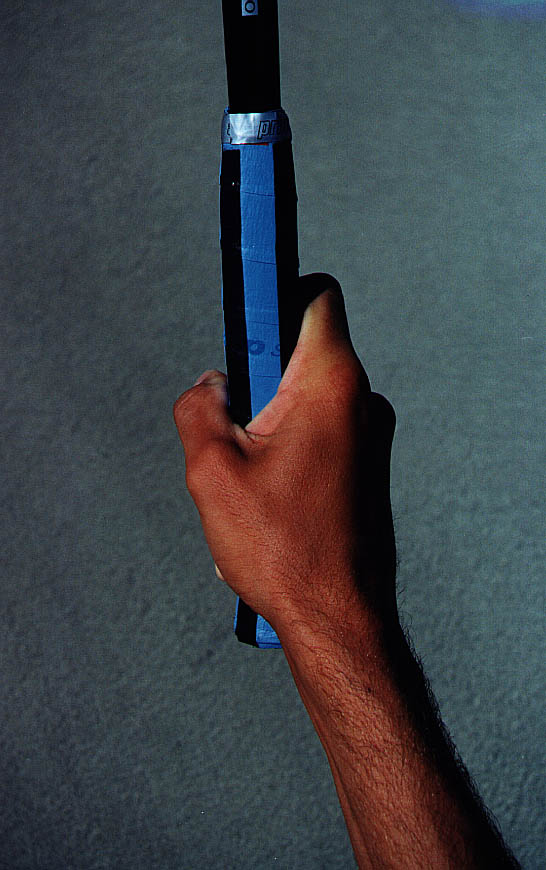
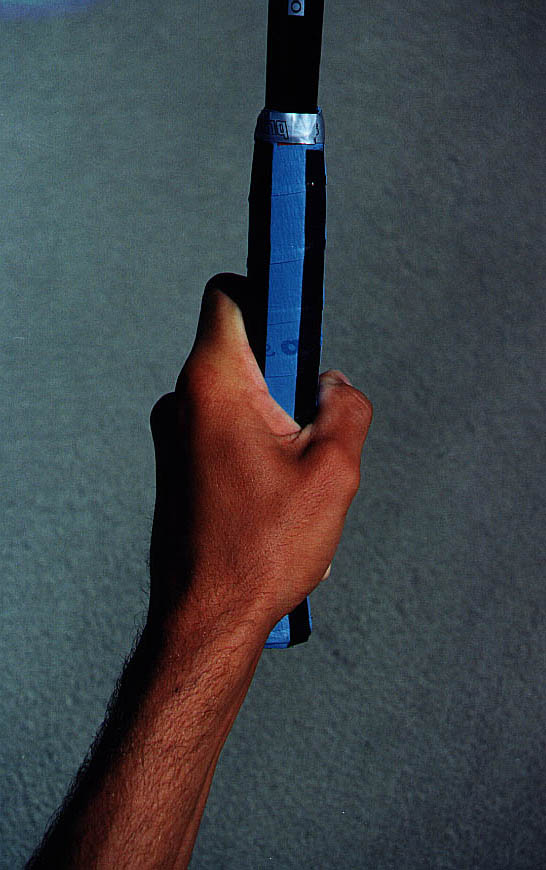
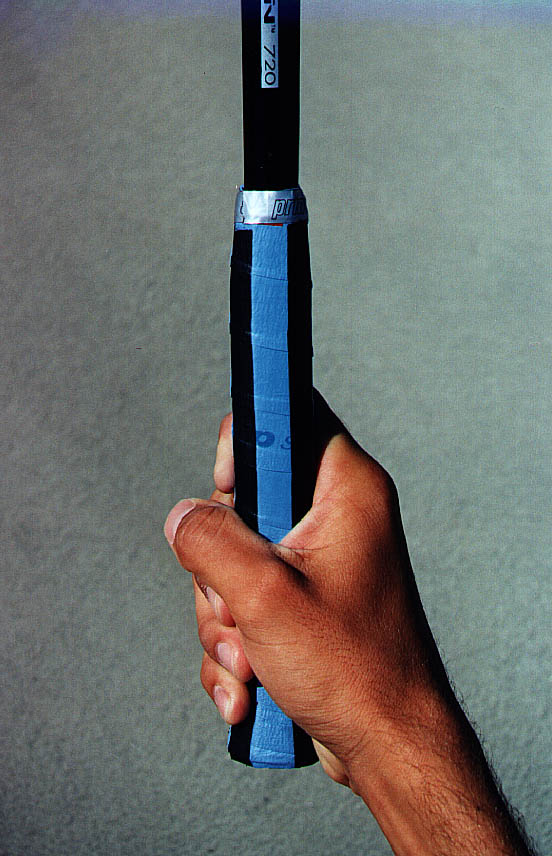
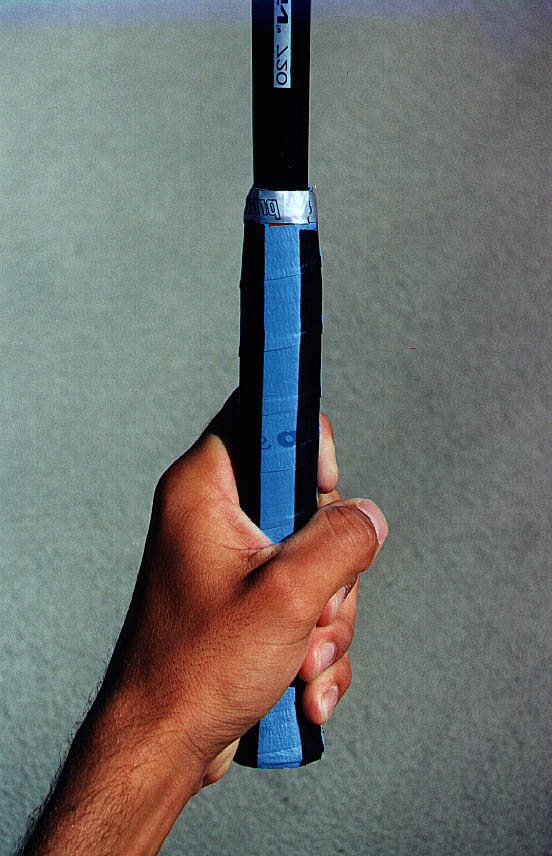
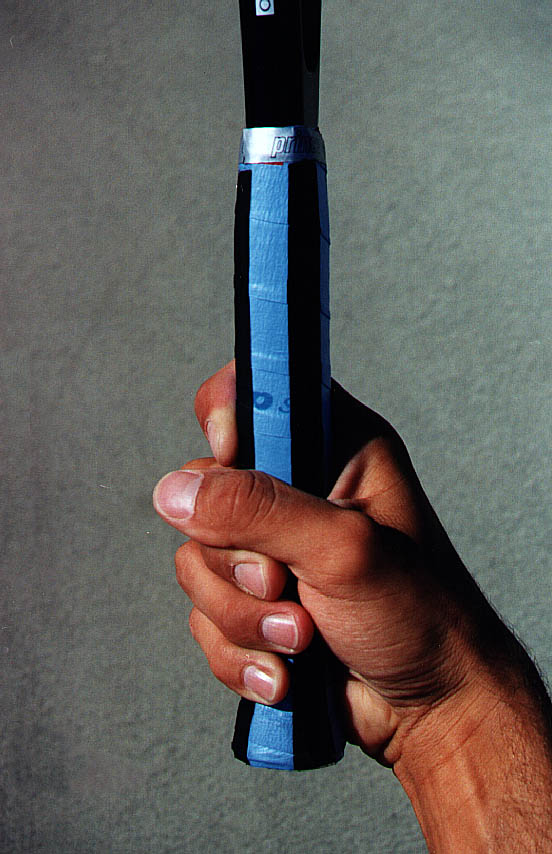
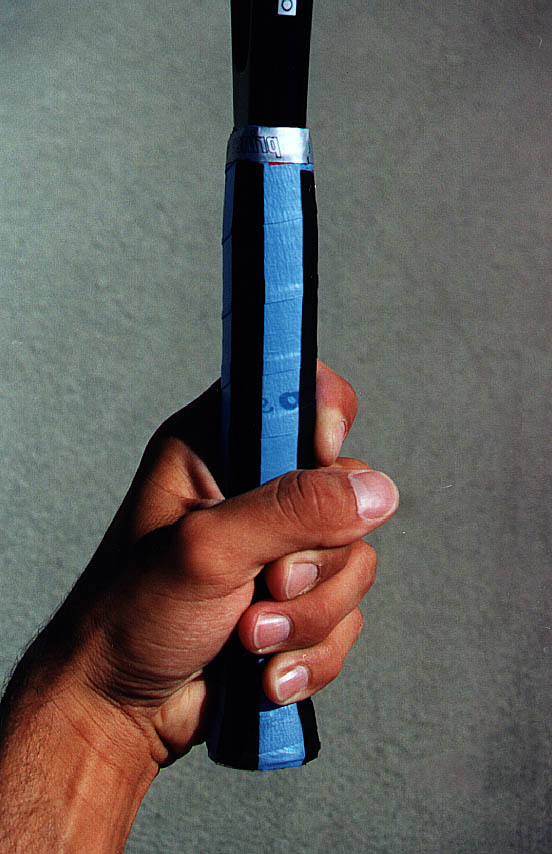
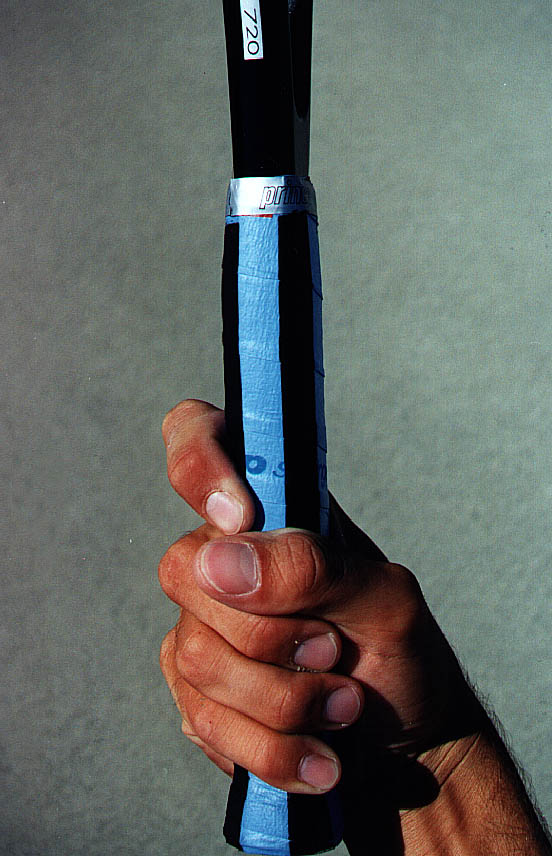
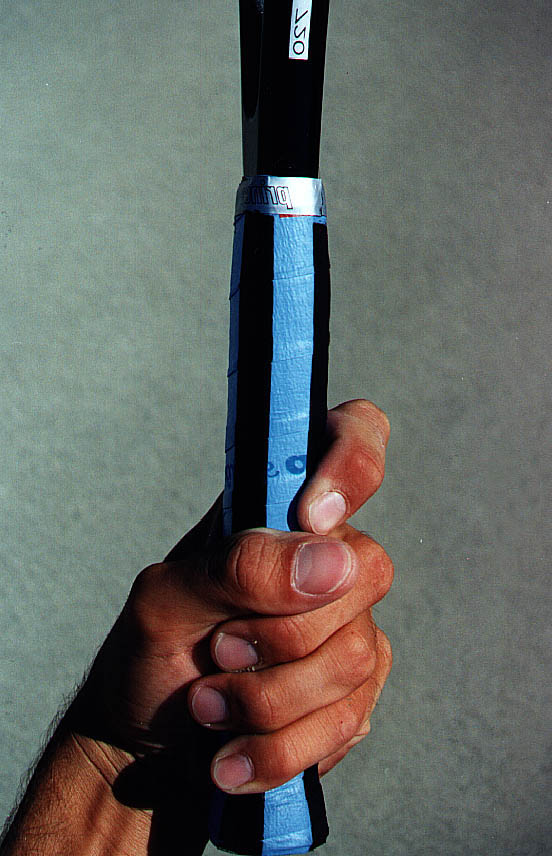
If you are like most players, your forehand is your better wing when it comes to groundstrokes. Given the muscle groups involved in producing this stroke, it is not surprising that it is often times the preferred side. If you have a fairly weak forehand or want a more powerfully consistent forehand, this month’s column is for you. Having photographed virtually all the pros on both tours and having coached for some time now, I can with confidence tell you that the following are the essentials to a great forehand. I have included illustrations in the form of photos to assist you in understanding these principles. GRIP There are only two grips that I recommend for the forehand groundstroke: the semi-western forehand grip and the eastern forehand grip. Now, some players will use a continental grip and others a full western. However, these latter two grips are so severe that they limit the ability of the player to quickly switch grips, as is necessary when volleying or hitting a groundstroke in an “emergency” situation. In addition, these two grips are very vulnerable to high and low bouncing balls, respectively. Here are some images that show each of the four grips. You will note that I have flipped the right-handed image to allow lefties to visualize the grips more easily. The Continental Grip: Here, your palm is essentially on the top bevel of the racquet handle. Note where the V in the player’s hand is located…it is essentially on the top of the racquet handle near the seam created by the top plane of the racquet handle and the top bevel.
The Eastern Forehand Grip: With this grip, your palm is basically on the side of the racquet handle. Note that the V in the player’s hand is essentially on the top bevel of the racquet handle.
The Western Forehand Grip: This is a great forehand grip for high bouncing clay surfaces, but is a bit difficult to wield on faster surfaces. With this grip, the palm is actually under the racquet handle. You must severely bend your wrist if you want to use this forehand grip. Note that the hand’s V is on the side of the racquet handle almost on the lower bevel.
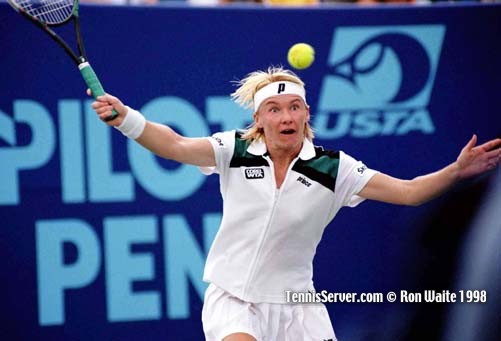
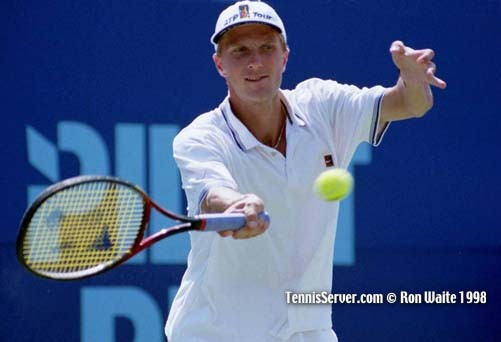
In addition to being comparatively “flexible” grips (meaning that they can be used effectively when hitting balls of low or high bounce height), the eastern forehand and the semi-western grips will make it easy to impart topspin. Topspin is an essential ingredient in the modern forehand in that it permits the player to hit the ball hard and still the ball is likely to bounce in-bounds. The topspin actually brings the ball down more quickly and forces it to bounce higher. These two actions give the player a good margin for error. In the modern game, one wants to be able to hit the forehand with as much pace as is controllable…topspin makes this possible. If you are confused about spin, please refer to my earlier column entitled, Become a Spin Doctor. Jana Novotna uses a continental grip when striking the forehand. Consequently, she is often times forced to slice the ball back…particularly if it bounces high. These slice forehands are great on low bouncing surfaces like grass, but are rarely powerful or effective on higher bouncing surfaces. It is no surprise that Wimbledon was Jana’s only grand slam championship. It is extremely difficult to hit topspin using the continental grip on the forehand side.
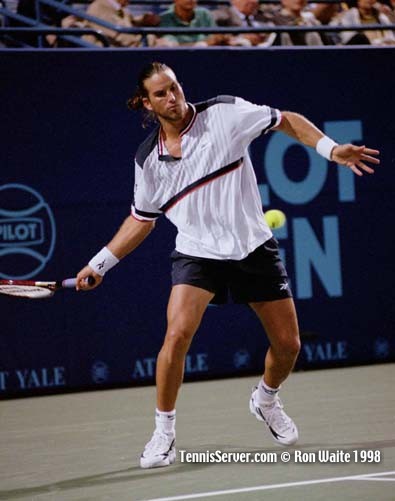
The following players, Patrick Rafter and Karol Kucera, are using the semi-western grip. Patrick’s grip leans a little bit toward the eastern forehand side and Karol’s leans a little toward the western forehand side. It is possible to have grips that fall in-between two “adjacent” grips. I hit my forehand primarily with the semi-western grip. My forehand grip is very similar to Karol Kucera’s.
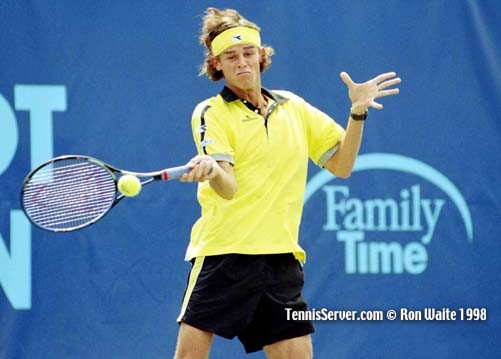
Gustavo Kuerten hits his forehand with a grip that is in between a semi-western and full western grip. When he first came on the tour, he was using a full western forehand. Now that he has moved it “back” a little bit, he is better able to compete on surfaces that are not likely to provide high bouncing balls.
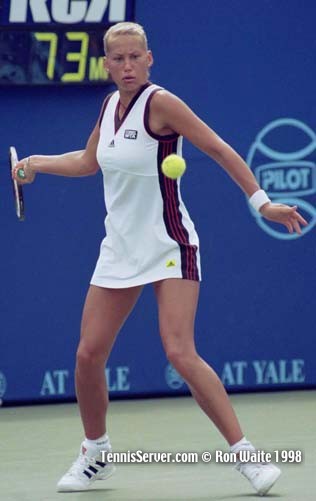
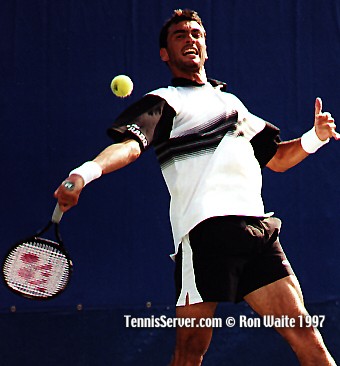
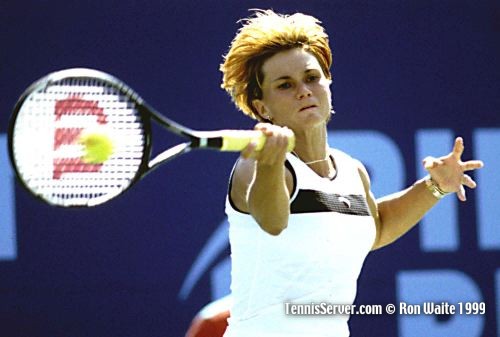
Lastly, we have players like Sergei Brugera and Ruxandra Dragomir who use the full western grip on the forehand side. Both of these players are at home on red clay. Given the high ball bounce on this surface, it is no surprise that they adopted the western grip.
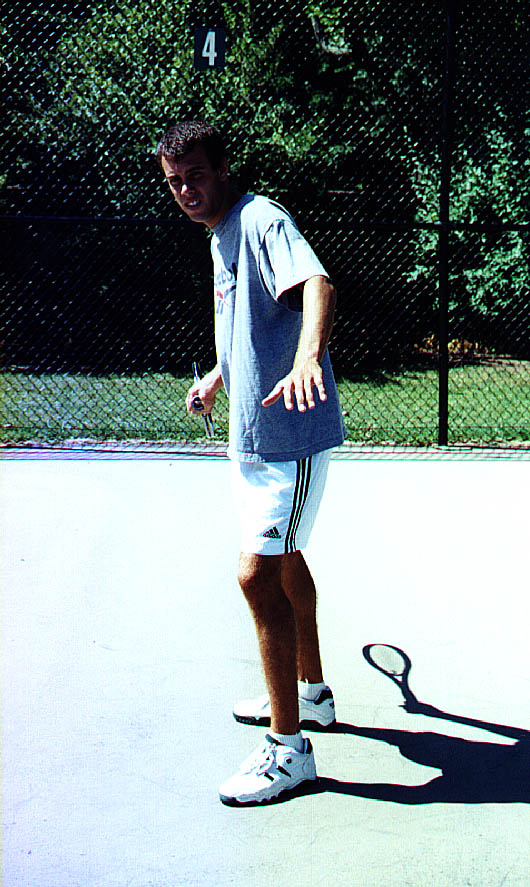
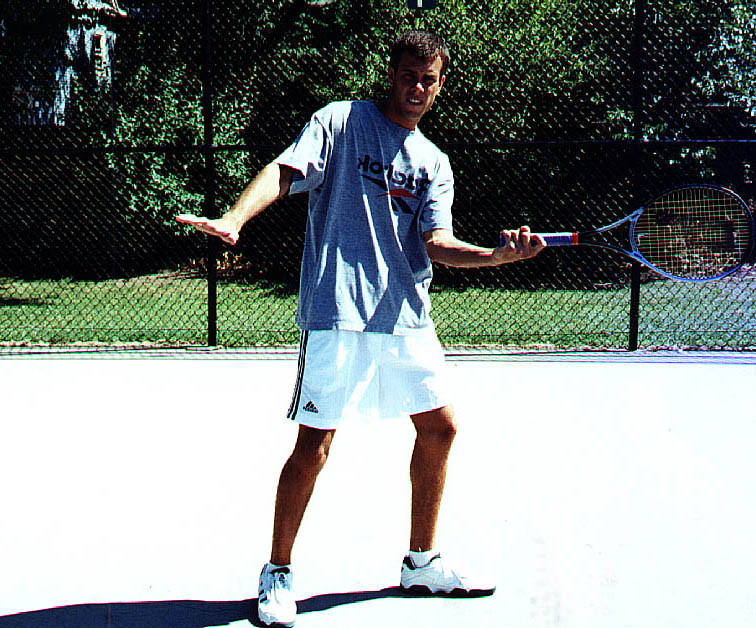
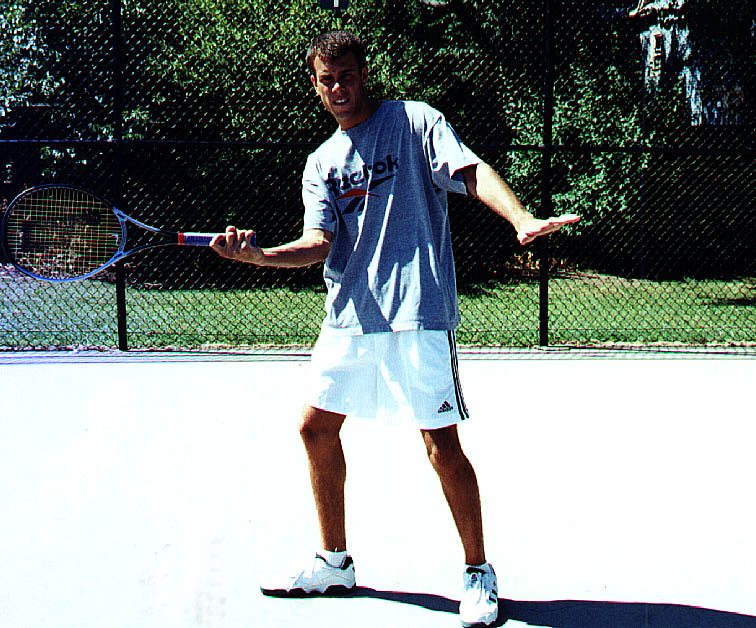
The best stances for the forehand groundstroke are the open and semi-open stances. An open stance is one where the player is facing the net. A closed stance is where the player is sideways to the net. In the semi-open stance, the player is about half-open and half-closed. In open stances and semi-open stances, the player is able to generate much power from the muscles in her/his arms, shoulders, body rotation and legs. In addition, the open stance and semi-open stance make it easier for a player to stop and recover (meaning move back to the center of the court) after hitting a shot. This is a closed stance. Here, Brent Starzyk is facing the camera, which is positioned at the net.
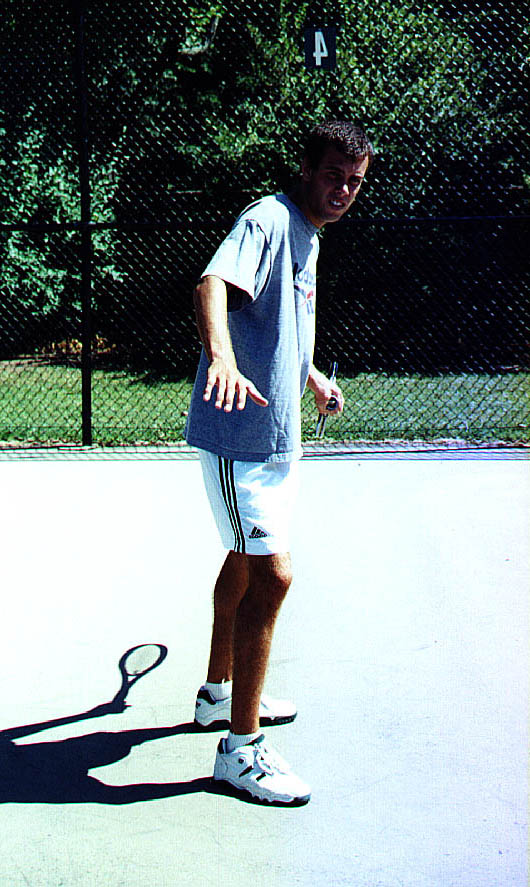
Although the camera position has changed in this shot, we can see that Brent has opened up his stance a bit. This is the semi-open stance.
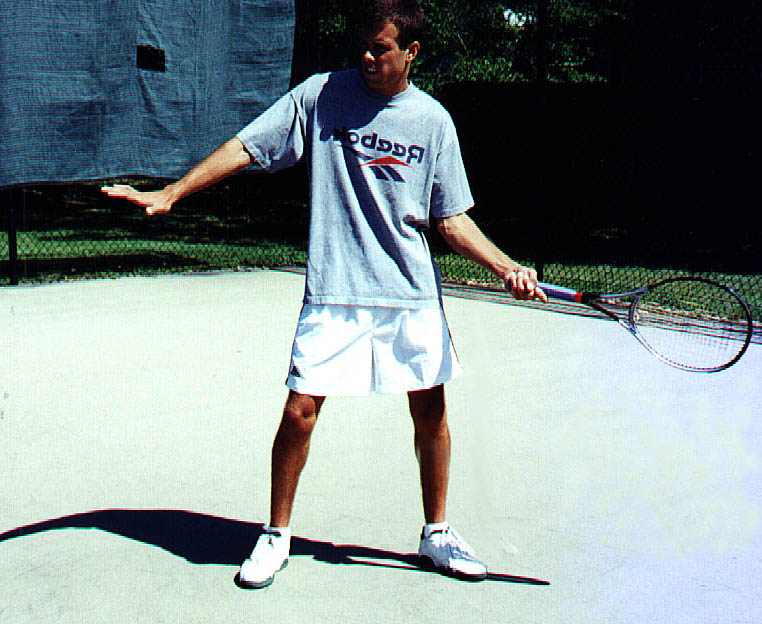
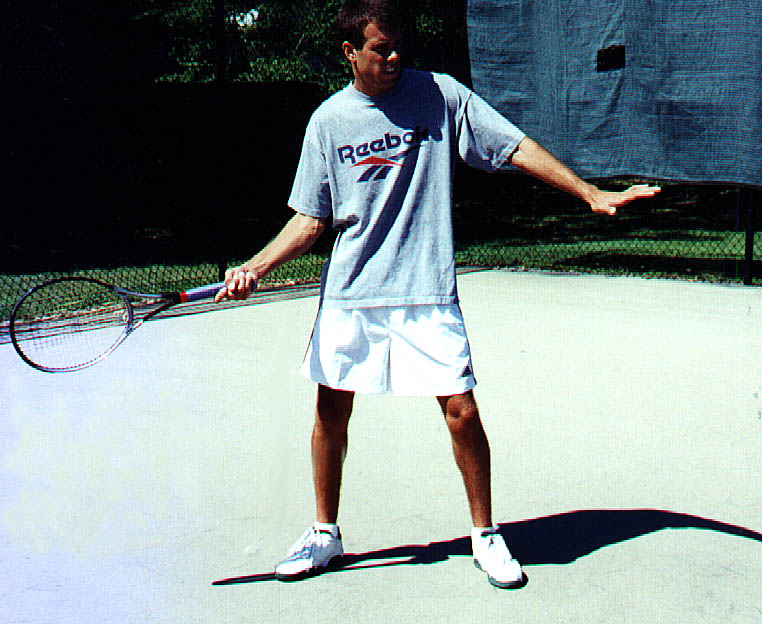
Moving back to our first camera position at the net, we see that Brent is now using a full open stance. (What grip is he using?…you guessed it, a very severe, full western grip.)
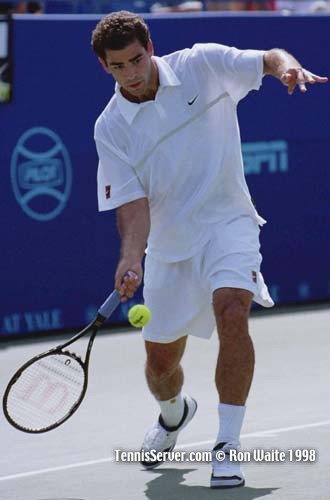
Whenever possible, try to hit your forehand from an open or semi-open stance. These stances work with every forehand grip except the continental. The continental can only be hit effectively when using a closed stance, and on occasion, a semi-open stance. Here is Pete Sampras using a semi-open stance to hit a forehand off a low bouncing ball.
Here is a shot of Pete Sampras using an open stance to hit a forehand. He uses what is essentially an eastern forehand grip. Notice that he is keeping his racquet face closed (facing the ground) as he brings the racquet back. This will enable him to impart the needed topspin.
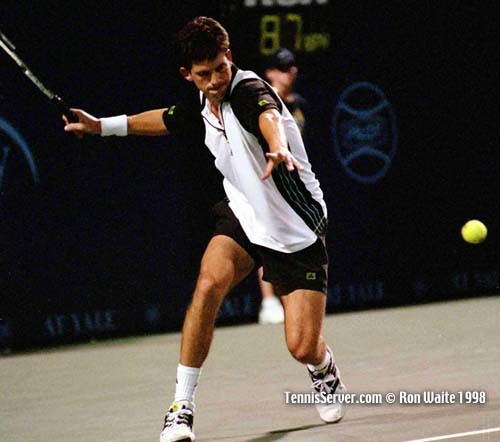
For you lefties, here is a shot of Greg Rusedski hitting a forehand…again from an open stance. By the way, he is using a semi-western grip. Semi-western and western grips automatically make the player hit in a way that imparts topspin.
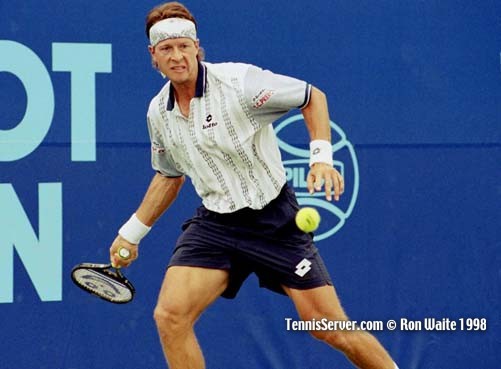
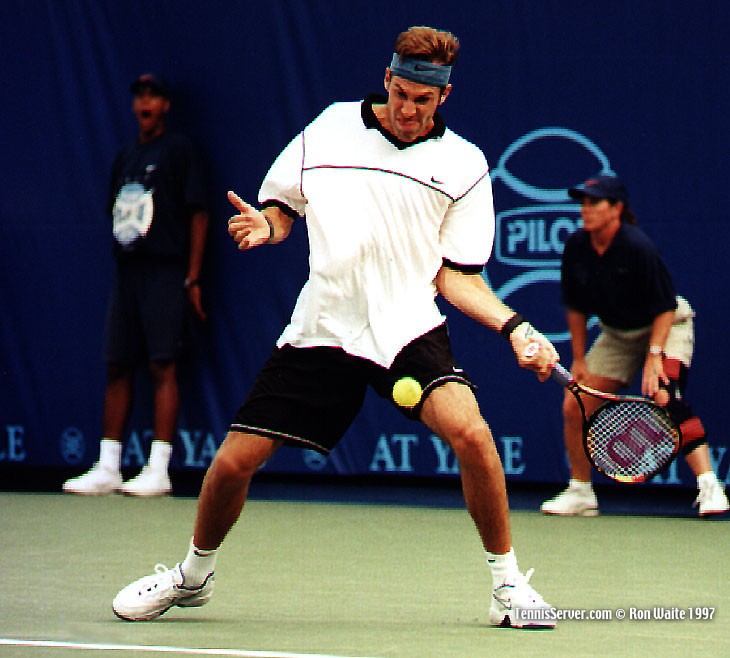
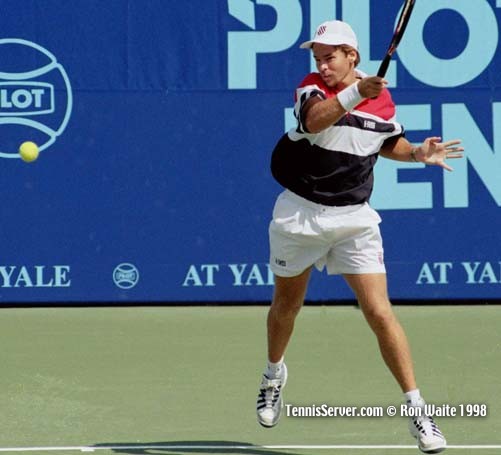
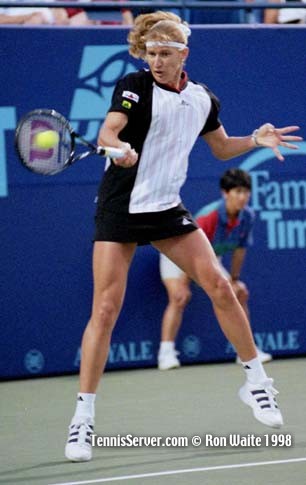
If you want to hit hard, penetrating, topspin forehands you must learn to lift your body at the moment of impact. If you watch the pros carefully, you will see that most of them are off the ground when they have finished the shot. By trying to lift your body while striking the ball firmly, the player will find that he/she can hit blazing forehands that almost always seem to land in bounds. To illustrate my point, here are some images of Lleyton Hewitt, Todd Woodbridge and Steffi Graf going airborne during their forehand groundstrokes.
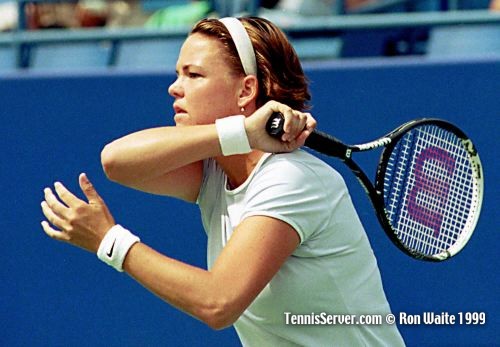
If you don’t go airborne during the forehand groundstroke, you can still impart topspin. However, the power of your stroke will diminish. This can be a way of settling your forehand down if you ever start to spray this shot. Watch the pros. When their forehands are off, they stop going airborne for a while. When the stroke returns, they go airborne once again. FINISH If you have ever trained at the Nick Bollettieri’s camp in Florida, you know the importance of finishing the stroke properly. Traditionally, players were taught to point the racquet in the direction of the ball’s path when finishing the shot. Well, I do not advise this. If you are using an eastern forehand grip, a semi-western grip or a western grip for your forehand groundstrokes, there is one and only one finish that I recommend. Try to finish the stroke with the racquet over your shoulder. This part of the stroke is absolutely critical for consistency. If you finish every forehand in this manner, I promise you that your forehand will improve by leaps and bounds in no time. Here is a picture of Lindsay Davenport executing what is the perfect forehand finish. We all know how powerful and consistent her forehand can be.
The final ingredient to a great forehand is keeping the head motionless at the moment of contact. The temptation is to look where the ball is headed…presumably to make certain that it landed in and to be ready for the opponent’s reply. Well, believe me -- you have more time than you realize. Pausing the head’s movement at the moment of impact will make your strokes consistent and predictable. The best way to control where the ball goes is to hit the ball off center opposite of the direction in which you want the ball to go. I know. This is confusing. Not to worry. My past article entitled Rock Around the Clock will make this facet of ball control clear. So the keys to a great forehand are:
A great way to practice these components and to implant them into your muscle memory is to hit off a backboard or wall. If you prefer to train with a ball machine or hitting partner, just be certain to hit every forehand to a target on the court. For more information on this topic, refer to my previous column entitled Target Practice. If you adopt these principles and practice them faithfully, I assure you, in no time, you will have a killer forehand. And when you do, you are sure to become a tennis overdog.
1996 - 2002 | 2003 - Present
This column
is copyrighted by Ron Waite, all rights reserved. Questions and comments
about these columns can be directed to Ron by using this form.
Ron Waite is a certified USPTR tennis instructor who took up the game
of tennis at the age of 39. Frustrated with conventional tennis methods
of instruction and the confusing data available on how to learn the
game, Ron has sought to sift fact from fiction. In his seven years of
tennis, Ron has received USTA sectional ranking four years, has successfully
coached several NCAA Division III men's and women's tennis teams to
post season competition, and has competed in USTA National singles tournaments.
Ron has trained at a number of tennis academies and with many of the
game's leading instructors.
In addition to his full-time work as a professor at Albertus Magnus
College, Ron photographs ATP tour events for a variety of organizations
and publications. The name of his column, TurboTennis, stems from his
methods to decrease the amount of time it takes to learn and master
the game of tennis.
|
 |





|


October 2022 Tennis Anyone: Patterns in Doubles by John Mills. September 2022 Tennis Anyone: Short Court by John Mills. |
