 |
March 2009 Article Turbo Tennis Archives:
Tennis Server
|
|
 You will join 13,000 other subscribers in receiving news of updates to the Tennis Server along with monthly tennis tips from tennis pro Tom Veneziano.



  |
|
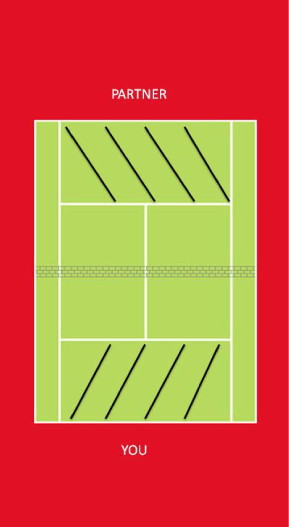
Here we are in March. There is an old adage, "In like a lion, out like a lamb." Well, let's hope that March allows for those of us north of the equator to begin outdoor practice and play. Collegiate players are already preparing for the spring season. Soon, high school teams will be up and running. For those of you who are recreational players, the promise of spring/summer competition looms in the not too distant future. Regardless of what category in which you may fall, I am quite certain that the prospect of playing this wonderful game outside again is entering your mind. If you follow my column faithfully, you know that the months of December, January and February should be dedicated to rest, cross training, strength training, stretching for increased flexibility, and aerobic training for speed and endurance. Hopefully as you read this, you are fit, and ready to approach the "pre-season" training period. Arthur Ashe is quoted as having said, "Practice does not make perfect. Perfect practice makes perfect." I couldn't agree more! Many players will just rush out to indoor or outdoor courts, hit balls aimlessly and attempt to play sets almost immediately. Instead of having a focused plan to recapture/improve their games, players will frequently just improvise. For many, this may be fun and enjoyable, but it usually does not result in clear and effective results. Like it or not, every player needs to have a time in her/his tennis year when drills are the mainstay of daily practice. Tennis is a game of muscle memory. Drills are an extremely important way in which players can re-establish and/or alter muscle memory. Drills provide the foundation for match play. Practicing the right drills can bring back a game more quickly, modify a game that needs change, and more importantly drills create a sense of confidence within the player. Tennis players of all levels compete best when they are on "auto pilot." How many times has your conscious mind interrupted your tennis "flow" on the tennis court? You are playing well and effortlessly. Suddenly, your mind kicks into gear and you start thinking about your strokes and/or your strategy. You begin to let the prospect of winning or losing... playing well or playing poorly... evaluating what is going on in a match... to creep into your thoughts. This almost always leads to poor performance! Sure, there are times when a player needs to think about what is going on in a match and what he/she may need to do differently. But, this should only occur when there is a good reason to entertain such thoughts. Certainly, there is no substitute for match play when one wants to become mentally tough for competition. But, rushing competition before a solid foundation has been put into place invariably allows thoughts that are really counterproductive to creep into our minds. Once we allow these thoughts to enter our mind during a set or match, we are faced with another battle... How can these thoughts be stopped? Yogi Berra is quoted as having said, "You can't play baseball and think at the same time." There is much wisdom in this statement, and it certainly applies to the game of tennis. You will frequently hear TV commentators, teaching pros and coaches say, "Play your game!" In my mind, this is well founded advice. One should always begin competition by playing the style of tennis that "fits" best. If this isn't sufficient in a given match, one may wish to consider going to Plan B or even Plan C. Of course my approach to competition in tennis assumes two things. First, you know what your game (Plan A) is. Second, you have solidified the strokes necessary to play your game. Drills actually help you re-discover, or even re-invent, your basic game plan. In addition, there is no better way to make certain that your strokes are built on solid ground than by engaging in frequent drills. With this in mind, I am putting forth in this month's column the 5 drills that I believe are absolutely essential. Truthfully, if a player did nothing more than these five drills for the next 4 to 8 weeks, I assure you that he/she would have significantly better results this tennis "season." In performing these drills, a player can integrate them into a training plan in a couple different ways. Each practice session can be dedicated to one and only one of these five drills, or all 5 drills can be weaved into each practice session. I personally like to spend a few weeks performing each of the 5 drills during every practice session. This allows me to get my overall game back in gear quickly, and affords me the opportunity to discover any weaknesses that need special attention. Weeks 3 through 5 for me are a mixture of alternating approaches. I will begin a practice week by doing all 5 drills in the first day's workout. The next day, I will focus on one, and only one drill. The third day, I return to weaving all 5 drills into my practice regimen. Day Four of a given week is dedicated to one and only one drill. I make certain that this is not the same drill that I performed on Day Two. This pattern continues throughout a six day week. On the seventh day, I make certain to put the racquets down. I either take a day off from all exercise, or I will cross train using a bike, weights, or by running. Weeks 6 through 8 find me doing all 5 drills every day. However at the end of each daily practice session, I will end practice by playing 3 tiebreaks with my hitting partner. These latter additions are a way for me to slowly introduce "competition" into the training routine. By the end of the 8 weeks, I am ready to start integrating playing full sets into my practice sessions. I may or may not do drills on a given day. Instead, I may simply attempt to play 2 or 3 sets. Eventually, I reach a point where I am playing sets more than I am doing drills. I never totally abandon drills, but I may minimize them in my weekly training plan. Each reader needs to discover for herself/himself what blend of drills works best. Frequently, this is a trial and error process. Eventually however, each player discovers the right regimen. I find that having a target date in mind is very helpful. I usually make June 1 my target date. By this date, I fully expect to be playing my best tennis. In Connecticut where I live, the climate is such that I can expect to play outdoors through September. So, I try to use the four months of June, July, August and September as my "tennis season." Given your schedule and climate, you may seek a longer or shorter season. Regardless of the length of your season, I strongly encourage you to prepare for this competitive time by engaging in pre-season preparation that incorporates these five drills. Consistency Drill If there is only one drill that every player needs in her/his training, it is the consistency drill. I first learned of this drill when reading about how Chris Evert would train with her father as a junior. The drill is extremely simple. Each player attempts to hit groundstrokes that land between the service lines and baselines. The goal is to work with each other... not to compete. Together, the players try to "rally" with as many balls landing within these zones as is possible. One player keeps count of the number of balls in a given rally. If a ball lands short (in the service box area), long or wide; the count starts again from zero. Although this drill is simple, it is not easy. Trying to get 25 consecutively hit balls to land within the "live" areas may take some time. Some years back, I had a hitting partner who loved this drill. We would engage in this drill every day. We could be fairly certain that we could reach a target goal of 50 consecutive shots in a rally within a half hour or so. On some days, we actually reached as many as 75. We were shooting for 100, but in truth, we never made it. Still on those days when we could rally in excess of 50, we knew that our groundstrokes were growing solid. Here is a simple diagram that illustrates the "live" areas for this drill.
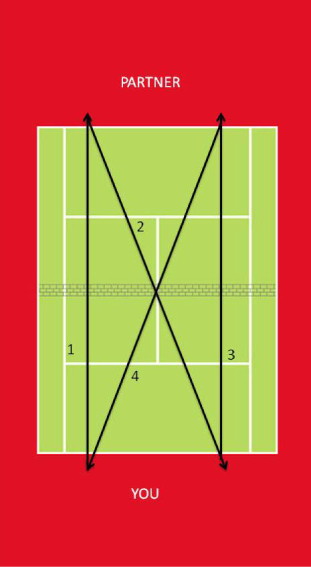
Figure 8 Drill This is a groundstroke drill that involves much more movement than is usually the case with the Consistency Drill. One player hits every groundstroke crosscourt. Her/his partner hits every groundstroke down the line. If you follow this pattern, you will see that each player is forced to run from side to side as he/she hits his/her partner's shots. It won't take you long to realize that one of you seems to be doing more running than the other. The person who is assigned to hit down the line will invariably be running wider to get to his/her partner's crosscourt shots. Thus, it is important to switch hitting roles frequently to avoid becoming too fatigued. Most players find that doing this drill for a total of 10 to 15 minutes, at least in the early stages of training, is about all that can be reasonably expected. If you are not in shape, this drill will tire you out very quickly. However, this drill can get you in aerobic shape quite nicely. Here again, each player wants to work with his/her hitting partner. The idea is to hit long rallies. The balls may land a bit short or be hit deep inside the court. Of course if a ball is hit long or wide, the drill is stopped, and then, resumed. I find it best if the player who is assigned the task of hitting down the line is the one to start a new rally with her/his feed. In the diagram below, I have numbered the arrows to give an idea of how the balls are hit. You will see how this drill gets its name. The arrows form a kind of sideways and angular figure 8. In my diagram, the player named, "You" is hitting every groundstroke down the line. The player named, "Partner" is hitting each groundstroke crosscourt. After 5 or 10 minutes of doing this drill, the "roles" would be reversed. "You" would now be hitting every groundstroke crosscourt, and "Partner" would be hitting each groundstroke down the line.
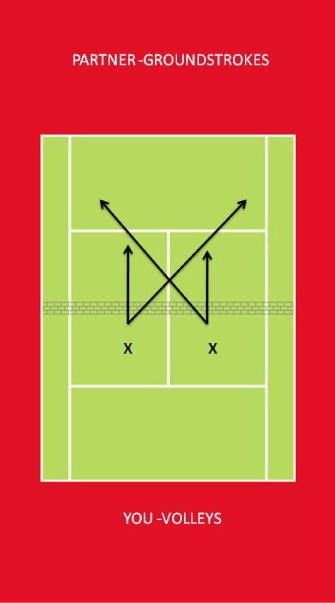
Volley Drill Quite often, tennis players will not practice their volleys as much as their groundstrokes. In the modern game of tennis, this is not surprising. Indeed, it is somewhat rare to see the serve/volley player in pro, collegiate, high school or amateur competitions. Still, we all need to be able to volley with effectiveness. It is an essential stroke... not an optional one. The following drill helps improve volleys. One player stands near the net. (Do not stand at the net. Why? Well, most volleys are hit some 3 to 4 feet from the net. Crowding the net during this drill is really not replicating what is likely to be your position in a match.) This player hits every shot as a volley that is directed crosscourt. The other player is at the baseline and is hitting groundstrokes to the player near the net. If the person hitting volleys directs the volleys crosscourt her/his partner can easily hit groundstrokes without having to move much. Groundstroke/volley rallies ensue. After a while the player near the net changes her/his target, and begins to hit every volley forward, not crosscourt. Although the partner hitting groundstrokes must reposition himself or herself, he or she should still not have to run to hit groundstrokes. Once again, groundstoke/volley rallies are possible. I like to begin this drill by having the net person stand in his/her ad court. After completing some rallies crosscourt and forward, this net player moves to the deuce side. Crosscourt and forward rallies are then hit from this deuce court position. Eventually, the players switch roles. The player who was hitting groundstrokes now becomes the person near the net who is hitting volleys. The original net person moves to become the player hitting groundstrokes. In the diagram below, I have indicated the two spots where the net player (in this case the player named, "You") should stand. These are identified by the two "X's." The arrows emanating from each of these two points indicate the two directions that volleys should be directed from each of these two locations.
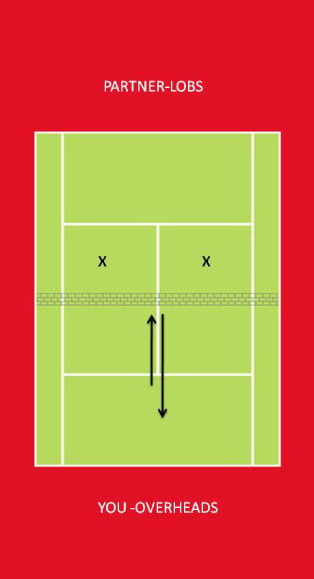
Overhead Drill How often do you practice your overheads? If you are typical, you don't practice them enough! If you do practice overheads, you may make the mistake of not forcing yourself to move back as you prepare for the smash. I have watched many players of all levels who simply practice overheads as they do when they are warming up for a match... without any real movement forward or back. In my overhead drill, a player must move to hit the smash! In my mind, any other overhead drill does not really prepare you for the reality of hitting smashes during a match. In real match play, the player almost always must move back from a net position to hit the smash. To do this drill, one player feeds lobs to the other. This "feeder" will do well to have a basket of balls next to him/her in order to keep his/her partner hitting overheads. One player stands near the net. The other (the feeder) hits a lob up that forces the net player to move back to hit an overhead smash. After hitting this smash, the player immediately runs forward and touches the net with her/his racquet head. As soon as the net is touch by this racquet head, the "feeder" sends up another lob. This lob forces the net person to move back again to hit another overhead smash. This pattern is repeated over and over. When hitting an overhead smash, the player wants to alternate hitting to each side of the court (deuce and ad). This is a drill that will fatigue the player hitting overheads fairly quickly. When this occurs, the players switch roles. Careful attention should be given to proper footwork as a player retreats to hit the overhead smash. Using crossover steps as a player moves back, and getting his/her racquet up into "ready position" early are key ingredients in performing this drill correctly. In the diagram below, the player named, "You" is moving forward and back to hit overheads. The player named, "Partner" is hitting lobs immediately after "You" has moved forward and touched the net with her/his racquet head. It takes a little practice to get the timing and depth of lobs down, but eventually, there emerges a rhythm and flow to this drill. The "X's" are the spots in each court where overhead smashes should be targeted.
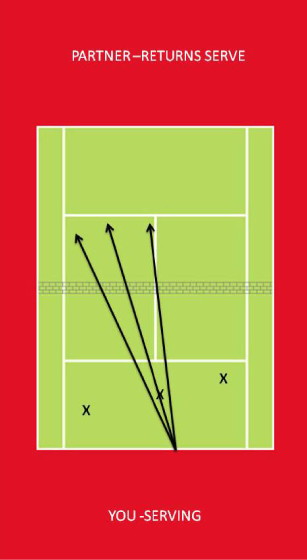
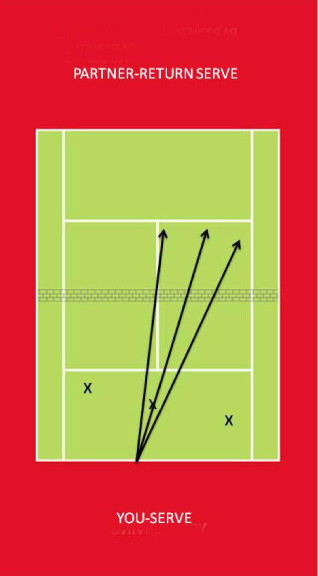
Serve/Return Drill The last of my five essential drills focuses upon control in both serving and returning serve. One player serves to the other. The server attempts to hit serves in a prescribed pattern. The first serve is directed wide. The second serve is hit to the center of the service box. The third serve is hit down the T. Then, the pattern is repeated. The server will need a basket of balls near her/him to perform her/his task. The player returning serve tries to return in one of three directions: crosscourt, center court and down the line. Again, I like to impose a pattern on these returns. First, all three serves (wide, center, down the T) are returned crosscourt. Second, all three serves (wide, center, down the T) are returned center court. Lastly, the three serves (wide, center, down the T) are returned down the line. The server hits 30 serves (10 sets of 3) to the deuce court. Then, the server hits 30 (10 sets of 3) serves to the ad court. Once these 60 serves are completed, the players switch roles. The returner now becomes the server and vice versa. Players when serving should not go for big first serves. Rather, every serve should be hit at three quarter pace. The goal is to control the direction of the serve. In like manner, the player who is returning serve should not try to return with lots of pace. Here again, the goal is to exert control over each return... not pace. In the two diagrams below, I have attempted to illustrate with arrows the three serves. The "X's" represent the target locations for returns of serve. In both of these diagrams, the player named, "You" is doing the serving and the player named, "Partner" is doing the returning of serve.
So, how does one incorporate all five of these drills into a single practice session?
This practice session will take you a little over an hour to complete. This is the bare minimum amount of time needed to complete all 5 drills in a single session. Quite frequently, players who intend to complete all five drills in a single training session will dedicate a minimum of two hours. As previously mentioned, some of these drills are more fatiguing than others. If you are dedicating an entire training session to just one drill such as the figure 8 drill, you probably will not be able to physically train for more than an hour. You and your partner will almost certainly need to take breaks within this hour. Other drills like the serve/return drill can be done for hours at a time without either player becoming fatigued. Finding reasonable ways to integrate these five drills into your spring training is a goal well worth pursuing. I assure you that if you do incorporate these drills that in no time you will become a tennis overdog!
1996 - 2002 | 2003 - Present
This column
is copyrighted by Ron Waite, all rights reserved. Questions and comments
about these columns can be directed to Ron by using this form.
Ron Waite is a certified USPTR tennis instructor who took up the game
of tennis at the age of 39. Frustrated with conventional tennis methods
of instruction and the confusing data available on how to learn the
game, Ron has sought to sift fact from fiction. In his seven years of
tennis, Ron has received USTA sectional ranking four years, has successfully
coached several NCAA Division III men's and women's tennis teams to
post season competition, and has competed in USTA National singles tournaments.
Ron has trained at a number of tennis academies and with many of the
game's leading instructors.
In addition to his full-time work as a professor at Albertus Magnus
College, Ron photographs ATP tour events for a variety of organizations
and publications. The name of his column, TurboTennis, stems from his
methods to decrease the amount of time it takes to learn and master
the game of tennis.
|
 |

|



October 2022 Tennis Anyone: Patterns in Doubles by John Mills. September 2022 Tennis Anyone: Short Court by John Mills. |
