 |
May 1998 Article Turbo Tennis Archives:
Tennis Server
|
|
 You will join 13,000 other subscribers in receiving news of updates to the Tennis Server along with monthly tennis tips from tennis pro Tom Veneziano.



  |
|
Some of you who read this month’s column’s title will invariably twitch with frightening memories of high school math. Well, not to fear. The geometry of tennis is really quite simple, and hopefully the accompanying diagrams will illustrate the principles in a manner that is clear and effective. As I begin, I must state that there exists two distinct types of players...those who analyze and think their way through a match, and those who hit on automatic pilot. Both types of players can be successful. However, neither can win consistently unless she/he conforms to the geometric rules of the game. In the case of the “heady” or thinking player, she/he will consider these geometric rules in crafting a game plan for each match. The “automatic pilot” player must use his/her practice time to instill shot selections that conform to these geometric rules...thus, the rules become part and parcel of this player type’s automatic program. Before we get to the diagrams and their accompanying explanations, let’s set forth the basic principles of court geometry:
RALLY CROSSCOURT
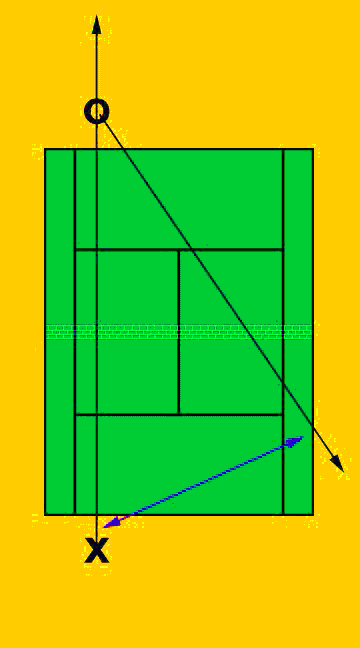
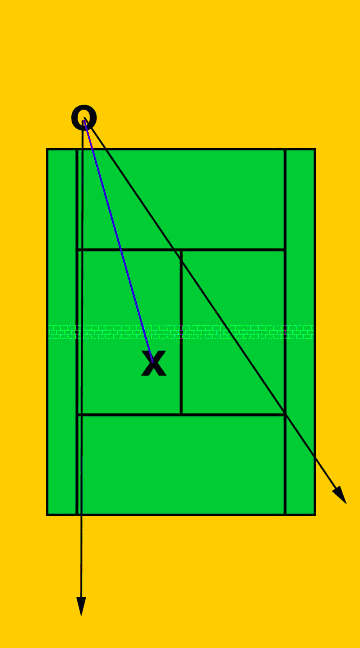
In fig 1, we see you (player “X”) hitting a groundstroke crosscourt. In figs 2 and 3, we see you (player “X) hitting groundstrokes down each of the two sidelines. If you are hitting groundstrokes from behind the baseline, you are in what is known as a rally position. This rally position is really a neutral or defensive position. It is rarely, if ever, an offensive shot location (It amazes me how often players try to hit winners from behind the baseline). If you read my earlier column, Percentage Tennis, you already know that it is usually better to hit rally groundstrokes crosscourt rather than down the line. The reasons for this include:
You will see that in fig 2 the distance that player “X” will have to run is significantly longer than the longest distance in fig 1. Unless you are extremely fleet of foot or enjoy running, hitting rally groundstrokes down the line doesn’t make sense because it gives a geometric advantage to your opponent. VOLLEY DOWN THE LINE
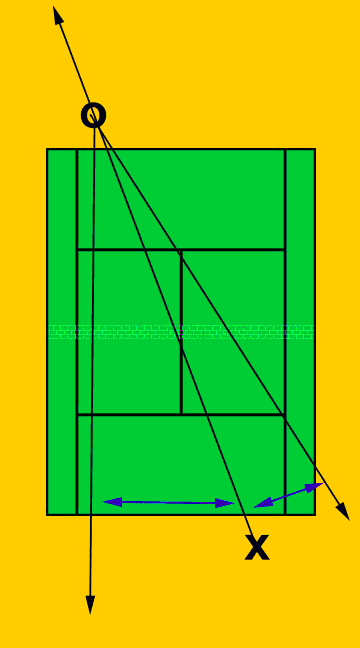
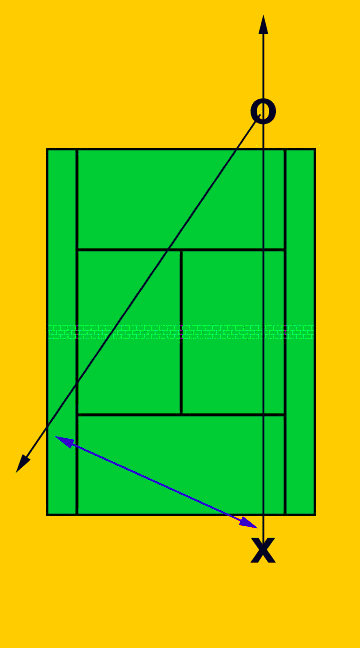
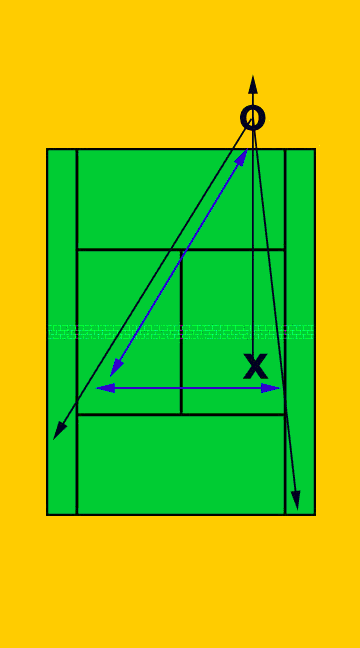
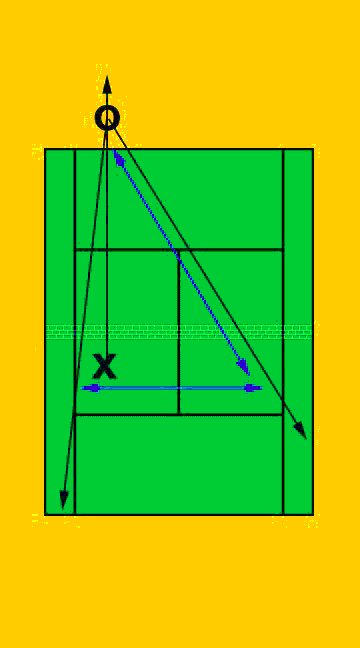
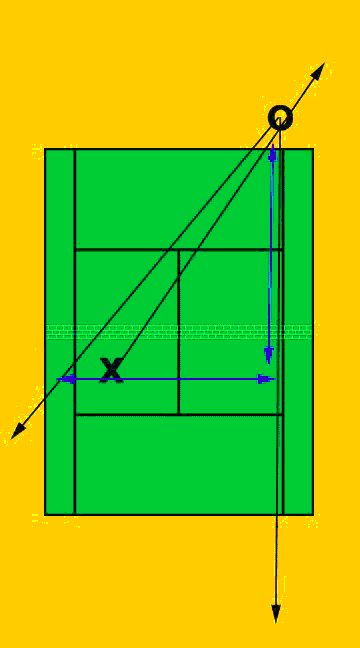
In figs 4 and 5, we see you (player “X”) hitting a volley down the line. In figs 6 and 7, we see you (player “X”) hitting the volley crosscourt. Unlike rally groundstrokes, volleys place you closer to the net. This court position greatly changes the geometry to which the player must conform. Essentially, the golden rule is to volley straight ahead. Since we are usually closer to one of the sidelines when we hit volleys (opponents are attempting to pass us), this golden rule usually means that we must volley down the line. In actuality, court geometry makes the down the line volley the wiser choice. If you examine figs 4 and 5, we see that player “X” has hit her/his volley down the line. The opponent (“O”) replies with a crosscourt pass. Difficult as this may be to defend, compare the amount of distance one has to run in figs 6 and 7. In 6 and 7, the volley is hit crosscourt and the opponent’s reply (“O”) is directed straight down the line. In this latter case, you would have to be very quick to cover the distance this reply commands. Although the actual difference in distance may at first seem minimal, you must realize that the opponent’s reply passes over the net more quickly when he or she is capable of hitting down the line as is evident in figs 6 and 7 (since the opponent is not hitting on a diagonal as is the case in 4 and 5...look at the blue lines!). Thus, the reaction time factor becomes an added factor. Suffice it to say that most volleys are best hit down the line. The only real exception occurs when you are at the net in the center of the court. Here, the angled volley hit away from your opponent offers the best chance of being a winner. THE CENTER THEORY
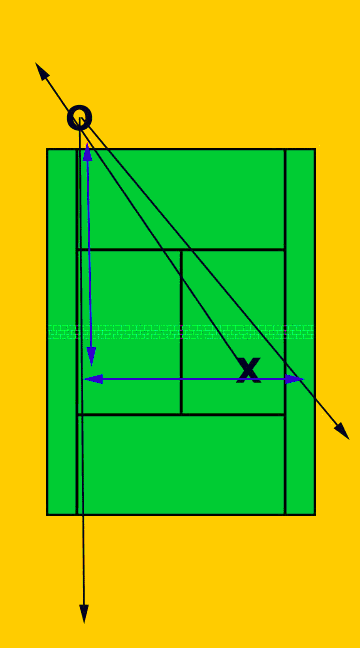
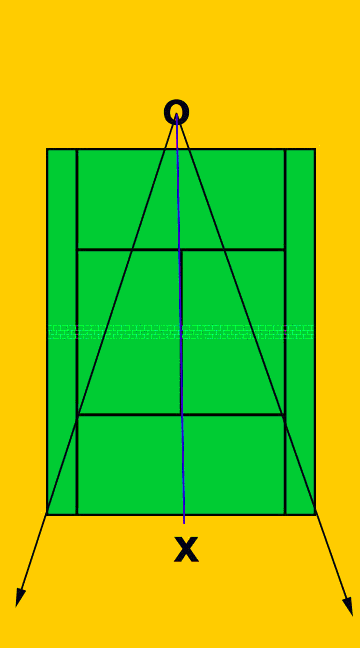
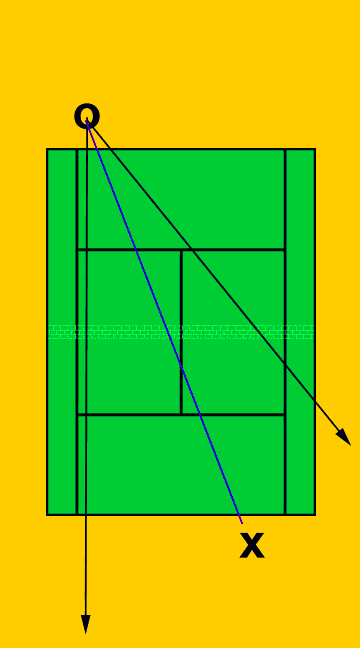
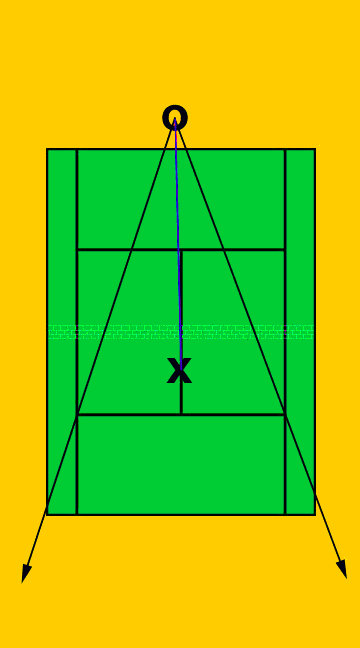
After hitting a shot (whether it is a groundstroke or a volley), the player must “recover” to a court position that affords him/her the best chance of getting at any possible reply from the opponent. In fig 8, we see that opponent “O” is at the center of her/his baseline. You, player “X”, should also be in the center of your baseline where you can cover either of the widest replies (represented by the white arrows) from your opponent. In fig 9, we see that the opponent, “O”, is again at her/his baseline but in this situation she/he is near a sideline. Once again, the white lines represent her/his widest possible replies. The blue line bisects the angle formed by these widest possible replies and places you, player “X”, in the center...thus, the name, center theory. In figs 10 and 11, we see the same situations only you, player “X”, are now at the net. Again, the blue line represents the center of court coverage given the opponent’s court position. The center theory suggests that you should always place yourself in the center of the range of your opponent’s widest possible replies. A simple way to know where you should be (assuming that angle bisection may not be easy for you to visualize during a point) is to place yourself on your court exactly where your opponent is on her/his court. For example, if your opponent is near the ad court sideline on his/her court, put yourself near the ad court sideline on your court. If the opponent is near his/her deuce court sideline, place yourself near your court’s deuce court sideline. If your opponent is in the center of his/her baseline, place yourself in the center of your baseline, etc. Many times, I see players scrambling to get back to the center court baseline position. Frequently, this is not the center of the opponent’s range of possible replies. As a result, the player runs hard...only to have the opponent hit behind her/him. If you follow the center theory, your chances of covering most replies greatly increases! Why? It is simple geometry. MOVING CLOSER TO THE NET INCREASES YOUR ANGLES
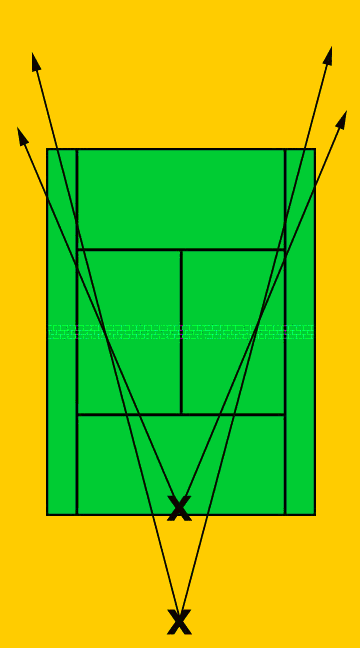 Figure 12 Click on Figures for a larger version We have all heard at least one TV commentator speak of tennis as a game of angles...which it most certainly is! The player who hits the most number of angled shots usually will win the match (Chart a match and see!). Of course, these angled shots (shots hit at a diagonal angle to the net) must land within the lines. One of the things that amaze me when I watch Andre Agassi or Monica Seles is the severely angled groundstrokes that they can hit. In part, these two pros hit such wonderful groundstroke winners because they use court geometry correctly. They realize that hitting groundstrokes at the baseline or even inside the baseline greatly increases the angle potential of their strokes. In fig 12, we see you, player “X”, hitting groundstrokes from two positions: behind the baseline and at the baseline. The wide arrows represent the widest possible range of groundstrokes you can hit from both positions. As you can see, the range is much wider when you are at the baseline. In fact, the range continues to increase the closer you get to the net. However, getting inside the baseline to hit groundstrokes usually requires the ability to strike the ball as it rises. For some players, this is not a viable and reliable way to hit the groundstroke. Regardless, each of us can benefit by trying to hit groundstrokes a bit closer to the net than we do normally. Even small changes, can make big differences in the kind of angles you are capable of creating! THE FOUR ZONES OF THE TENNIS COURT
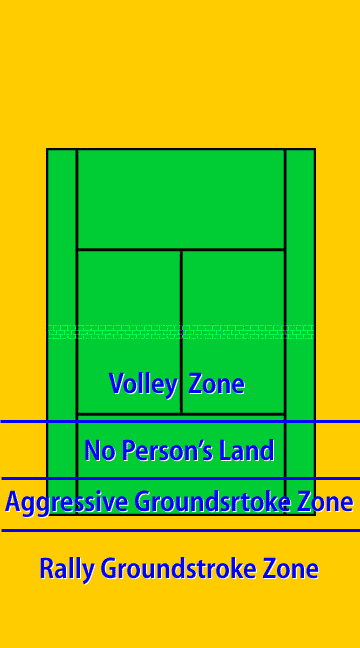 Figure 13 Click on Figures for a larger version The final area that I would like to address in this month’s column involves what I call the zones of the tennis court. When teaching juniors tennis, I often place colored tape on the court to delineate each of the four zones. These four zones are represented in fig 13 above. The Rally Groundstroke Zone is where most groundstrokes are hit...behind the baseline! From here, the goal should be to keep the ball in play...not to go for a winner! When you are in this zone, you should try to move your opponent around, vary ball spins, vary ball height and wait for an opportunity to be aggressive. The Rally Groundstroke Zone is essentially a neutral or defensive court position...in part, because the court geometry does not permit winning angles. The Aggressive Groundstroke Zone can be a very offensive position. Here, you are standing at the baseline or inside the baseline. Even this small advance toward the net permits the player to be more aggressive in her/his shot selection. Moving your opponent around becomes easier. Heavy, hard hit, angled groundstrokes frequently result in out-and-out winners. This is Agassi’s and Seles’ favorite court position. Given the angles they use and the pace with which they strike their groundstrokes, they rarely need to go to the net to hit an out-and-out winner. No Person’s Land is the area of the court that most, if not all, of us hate. In this zone, we are too close to the net to hit groundstrokes because the ball usually bounces at our feet. Volleys are equally difficult because we must get very low to strike the ball and usually we cannot volley deep into the opponent’s court from this position. Consequently, the half volley is our only option. Half volleys require timing and finesse. Even those of us who strike the half volley must admit that it usually is a defensive shot. Thus, whenever possible, avoid getting caught in No Person’s Land. The best way to avoid this problem zone is to drive to the net whenever you move inside the baseline. This may not always be possible or even desirable (especially if your volleys are a rumor). In the modern game, big groundstroke players like Seles and Agassi will often charge the net and hit the swing volley. In this way they avoid No Person’s Land...yet, they still charge toward the net. Whatever you do, never move backwards unless there is no other choice. I have a simple rule: I never move backwards unless I am behind the baseline (as is frequently necessary when playing clay court tennis) or when I go back for an overhead. Once I start moving forward, I force myself to keep moving forward. I may lose the point, but I don’t want to lose it because I was caught in No Person’s Land. Moving forward offers no guarantees, but it minimizes the number of times you’ll be trapped in this zone! Lastly, we come to the volley zone. For most of us, this zone ranges from a few feet behind the service line to four or five feet from the net. When you find yourself in this zone, volleys are the norm. On occasion, you’ll be forced back by an opponent’s lob and have to hit an overhead smash. The Volley Zone is an inherently offensive area of the court. Here, the court geometry favors the volleyer. However, I offer one word of caution. Don’t expect to win points on the first volley. Sometimes you can, but more often than not you’ll need a second volley to finish the point. (Chart a match and count the number of volleys needed to win the point!). Court geometry is an area of the game that each of us needs to address if we want to play at our best. Spend some time coming to terms with this mathematical side of tennis and I assure you that in no time you'll become a tennis overdog! Good luck in your game!
1996 - 2002 | 2003 - Present
This column
is copyrighted by Ron Waite, all rights reserved. Questions and comments
about these columns can be directed to Ron by using this form.
Ron Waite is a certified USPTR tennis instructor who took up the game
of tennis at the age of 39. Frustrated with conventional tennis methods
of instruction and the confusing data available on how to learn the
game, Ron has sought to sift fact from fiction. In his seven years of
tennis, Ron has received USTA sectional ranking four years, has successfully
coached several NCAA Division III men's and women's tennis teams to
post season competition, and has competed in USTA National singles tournaments.
Ron has trained at a number of tennis academies and with many of the
game's leading instructors.
In addition to his full-time work as a professor at Albertus Magnus
College, Ron photographs ATP tour events for a variety of organizations
and publications. The name of his column, TurboTennis, stems from his
methods to decrease the amount of time it takes to learn and master
the game of tennis.
|
 |

|



October 2022 Tennis Anyone: Patterns in Doubles by John Mills. September 2022 Tennis Anyone: Short Court by John Mills. |
